Ubisoft’s popular Just Dance franchise has evolved beyond console-bound gameplay, thanks to innovations like Just Dance Now, which lets users dance along to choreographed routines using only a smartphone and a screen. Issued patent U.S. Pat. No. 9,782,670 helps explain how the experience is delivered, even when players don’t have the full game pre-installed. The patent outlines a system for cloud-based participation in interactive events, most notably dance games, by leveraging multiple personal devices and a real-time feedback infrastructure.
One of the cool features of the ’670 Patent is that it allows users to join a dance session on demand. When a player requests to participate, the system can transmit the necessary executable code to their device, enabling the game to launch without prior installation. The delivery of game logic supports a flexible model for interactive content, meant for quick, on-the-go access via smartphones or tablets.
Another interesting feature of the patent is the program’s ability to collect and analyze input from multiple personal devices. For instance, a smartphone may serve as the motion-tracking controller using built-in accelerometers, while a second device, like a smartwatch or microphone-equipped accessory, captures additional data or records video or audio. The system can then use this sensor data to generate a performance score and even share recorded clips back to the player or across devices.
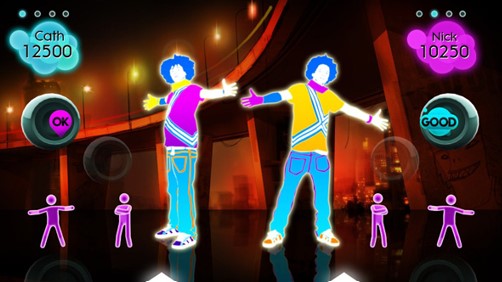
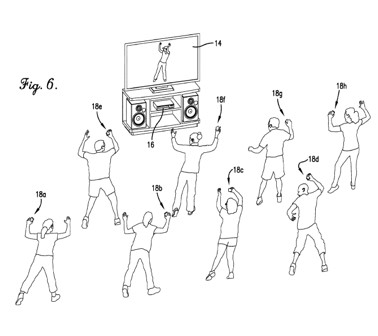
The patent describes scenarios where these interactive events include multiplayer environments, referred to as “dance rooms.” Players from different locations can compete in real-time, receive feedback, and view live or asynchronous leaderboards. For IP professionals and game developers alike, this patent provides a glimpse into how dance gaming went mobile without missing a beat!
Illustrative Claim:
1. A non-transitory computer readable storage medium with an executable program stored thereon for participating in an interactive event, wherein the program instructs a processing element to perform the following steps:
receiving a request sent by at least one client device for participating in an interactive event,
wherein the client device does not have executable code for the interactive event when the request is sent;
responsive to the request, transmitting executable code for the interactive event to the at least one client device to allow the interactive event to be shown on a display;
receiving feedback related to a performance from at least one first personal input from a first input device and from at least one second personal input from a second input device, wherein the feedback is in the form of sensor data or a score,
wherein the first input device is distinct from the second input device,
wherein at least one of the first input device and the second input device is associated with the client device;
receiving a recording from the at least one second personal input,
wherein the recording is captured from a sensor located on the at least one second personal input; and
transmitting the recording to the at least one client device to be shown on the display.